When a cold Portland east wind starts howling through the Gorge and your furnace won't turn on, the house can get uncomfortable fast. Before you pile on every blanket in the closet, there are a few simple, safe checks you can do that often get the heat running again—without guessing or risking damage.
This guide walks Portland-metro homeowners through step-by-step furnace troubleshooting, from the thermostat to the breaker, gas supply, filter, and common safety switches. We’ll also be clear about where DIY should stop, especially when gas, ignition, and carbon monoxide are involved.
Key takeaways
- Many “furnace not working” calls turn out to be thermostat, power, or filter issues you can fix yourself.
- Never bypass safety switches or work on gas piping, ignition systems, or internal wiring without proper training.
- Carbon monoxide safety matters more than getting the heat on—if in doubt, shut the system off and get help.
- If your furnace repeatedly shuts down or goes into safety lockout, it’s time to call a professional.
- Northwind Heating & Cooling offers same-day heating & furnace repair across the Portland metro when DIY steps don’t solve it.
Step 1: Confirm the thermostat isn’t the culprit
A surprising number of “furnace no heat” situations in Portland turn out to be thermostat issues. Start here—it’s fast and safe.
Basic thermostat checks
- Make sure it’s on “Heat.”
- If it’s set to “Cool” or “Off,” your furnace won’t start.
- Raise the set temperature.
- Set the thermostat at least 3–5°F higher than the current room temperature.
- Wait a full minute to see if the furnace responds.
- Check the fan setting.
- “Auto” is normal. “On” will run the blower continuously, even without heat—this can make it feel like the furnace is working when it’s only moving room-temperature air.
- Look for error messages or low battery icons.
- If the display is blank or dim, replace the batteries (if your thermostat uses them).
When to suspect the thermostat itself
You may be dealing with a thermostat problem if:
- The screen is blank even after new batteries.
- The thermostat clicks but the furnace never starts.
- Other systems (like AC in summer) also don’t respond.
At this point, replacing the thermostat or checking low-voltage wiring is usually better left to a pro. A miswired thermostat can short out furnace control boards—an expensive mistake.
Pro tip from the field: If you recently had a new smart thermostat installed and your furnace won’t turn on consistently, the thermostat may not be compatible with your system’s wiring. We see this often after DIY thermostat swaps.
Step 2: Verify power to the furnace
Portland’s older homes, especially in inner NE and SE, often have quirky electrical panels and shared circuits. A tripped breaker is one of the most common reasons a furnace won’t turn on.
Check your breaker panel
- Locate the main electrical panel.
- Common locations: basement, garage, utility room, or exterior wall.
- Find the furnace or HVAC breaker.
- It may be labeled “Furnace,” “FAU,” “Air Handler,” or “HVAC.”
- Identify a tripped breaker.
- A tripped breaker may sit between ON and OFF, or feel loose compared with the others.
- Reset correctly:
- Push the breaker firmly to the OFF position first.
- Then push it back to ON until it clicks.
If the breaker trips again immediately or within a short time, don’t keep resetting it. That’s a sign of an electrical fault, short, or failing motor that needs professional diagnosis.
Check the furnace switch
Most furnaces also have a service switch nearby that looks like a regular light switch.
- Make sure it’s in the ON position.
- If someone was recently working in the area (storage, cleaning, other contractors) it may have been turned off accidentally.
If you’ve confirmed power and your furnace is still not working, move on to the gas supply and airflow checks.
Step 3: Confirm gas supply (for gas furnaces)
In the Portland metro, natural gas furnaces are common, especially in homes built from the 1990s on. If your gas supply is off or interrupted, your furnace won’t ignite.
Safe gas checks you can do
- Check other gas appliances.
- If your gas stove or gas fireplace won’t light either, you may have a larger supply issue.
- In that case, contact NW Natural or your gas provider.
- Look at the furnace gas shutoff valve.
- There’s usually a manual shutoff valve on the gas line near the furnace.
- The handle should be parallel to the gas pipe when it’s ON.
- If it’s perpendicular, the gas is turned OFF.
If the valve was off and you’re comfortable doing so, you can turn it back on slowly. If you smell gas at any point:
- Stop immediately.
- Do not light anything, flip switches, or use your phone near the area.
- Leave the home and call your gas company and/or 911 from outside.
Safety first: If you ever smell rotten-egg odor near your furnace, treat it as a potential gas leak. Don’t try to troubleshoot further—evacuate and call for emergency help.
Step 4: Inspect and replace the furnace filter
In the damp Pacific Northwest, filters can load up quickly with dust, pet hair, and even fireplace soot. A severely clogged filter can cause a furnace no heat situation by triggering safety systems.
How a dirty filter can stop your furnace
- Reduces airflow, causing the furnace to overheat.
- Triggers the high-limit safety switch, shutting the burner off.
- In some cases, repeated overheating will put the system into lockout, where it refuses to restart until reset.
Check and change the filter
- Turn the furnace off at the thermostat (set to OFF).
- Locate the filter:
- Common locations: in the return air grille, in a slot on the side/bottom of the furnace, or inside the blower compartment.
- Slide the filter out carefully. Note the airflow direction arrow on the frame.
- Inspect it against a light.
- If you can’t see light clearly through it, it’s overdue for replacement.
- Install a new filter of the correct size and type.
- Match the airflow arrow with the direction of airflow (usually toward the furnace).
For most Portland homes, changing 1-inch filters every 1–3 months is a good rule of thumb, especially during extended cold snaps when the furnace runs often.
Step 5: Check the condensate drain and safety switch (high-efficiency furnaces)
Many high-efficiency gas furnaces installed in Portland suburbs like Happy Valley, Beaverton, and Vancouver are condensing models. They produce condensate (water) that must drain away properly. If the drain backs up, a safety device can shut the furnace down.
Signs of a condensate problem
- Furnace tries to start, then quickly shuts down.
- You hear gurgling near the furnace.
- Visible water around the base of the furnace or in the drain pan.
What you can safely check
- Locate the condensate drain line.
- Usually a small PVC pipe leaving the furnace and running to a floor drain, condensate pump, or nearby sink.
- Look for obvious kinks or disconnections.
- Gently straighten any kinks in flexible tubing.
- Check for a full condensate pump reservoir.
- If you have a small pump, make sure it’s plugged in and the reservoir isn’t overflowing.
You may see a float switch or safety device that shuts the furnace down if the drain backs up. While you can visually inspect it, avoid disassembling or bypassing it. That safety is there to prevent water damage and, in some cases, unsafe combustion.
If you suspect a clogged condensate line, it’s often worth having a technician clear and flush it professionally. We frequently find mold, sludge, or improper slopes that homeowners can’t easily correct.
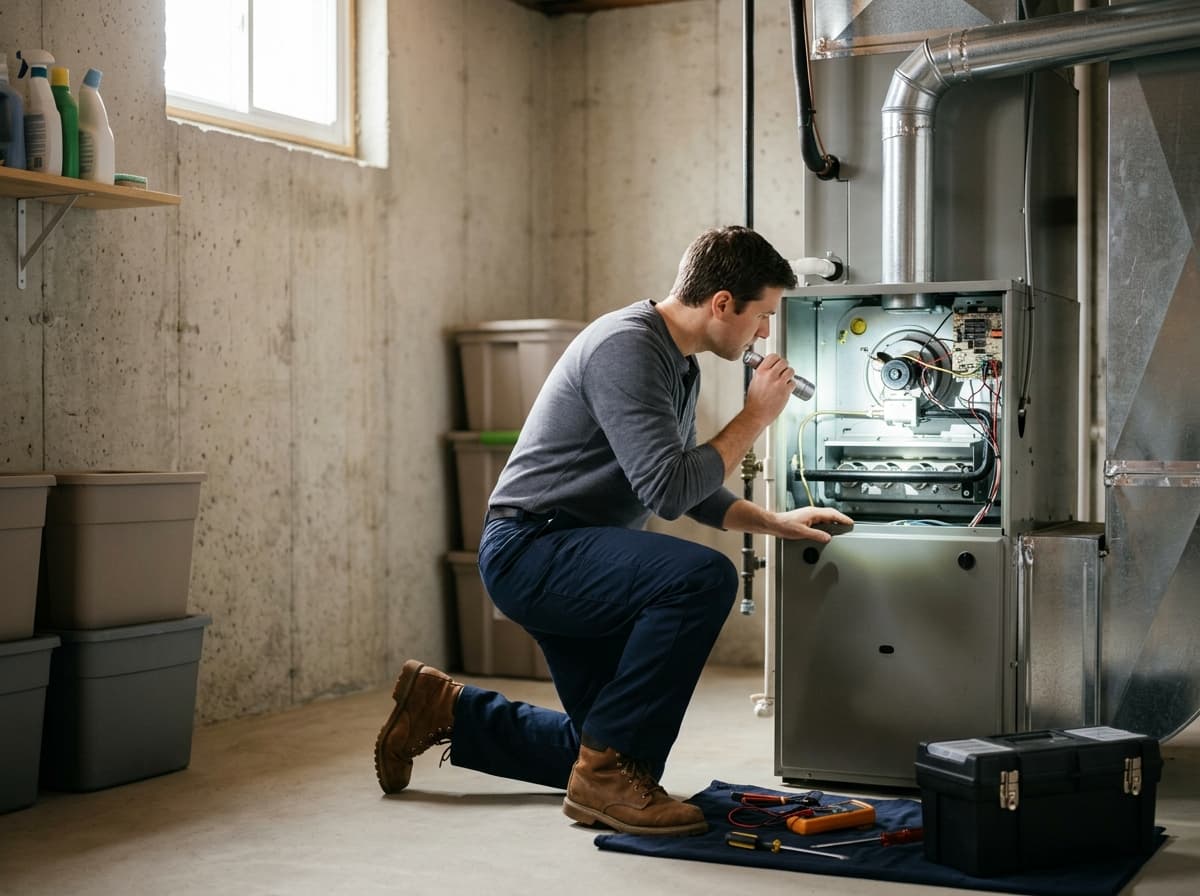
Step 6: Understand ignitor and flame sensor issues (don’t DIY beyond visual checks)
If your thermostat, power, gas, and filter all check out, the problem may be in the ignition or flame sensing system. At this point, DIY should be very limited.
How modern furnaces start
Most newer furnaces in the Portland area use hot surface ignitors (HSIs) instead of standing pilot lights. The basic sequence:
- Thermostat calls for heat.
- Draft/inducer motor starts.
- Ignitor glows bright orange.
- Gas valve opens and burners light.
- Flame sensor confirms flame is present.
- Blower fan comes on.
If the flame sensor doesn’t confirm flame, the furnace will shut the gas off and often retry a few times before going into safety lockout.
Symptoms of ignitor or flame sensor problems
- Furnace clicks repeatedly but never fully lights.
- You see the ignitor glow, but burners don’t stay lit.
- Furnace starts and shuts off after a few seconds.
- LED indicator lights on the furnace control board flash an error code.
Important: Handling ignitors or flame sensors with bare hands, or cleaning them aggressively, can shorten their life or damage them. We replace dozens of prematurely failed ignitors each season due to well-intentioned DIY cleaning.
What’s safe for homeowners to do
- You can remove the furnace’s lower access panel to see if there are any visible error code charts and LED indicators.
- Note any flashing patterns and share them with your technician.
Beyond that, adjustment or replacement of ignitors and flame sensors should be done by a licensed HVAC technician. These parts are delicate, and mistakes can lead to misfires, cracked components, or unsafe combustion.
Step 7: Recognize furnace safety lockout and error codes
Modern furnaces are designed to err on the side of safety. If something doesn’t look right—poor ignition, overheating, airflow issues—they often go into lockout, where the burner won’t try to start again until reset.
How to identify lockout mode
- The furnace is unresponsive even though the thermostat is calling for heat.
- You see a blinking LED on the control board through a small sight glass.
- A sticker or diagram on the furnace panel lists error codes (e.g., 3 flashes = pressure switch error).
You can sometimes reset the furnace by:
- Turning the thermostat to OFF.
- Turning the furnace switch OFF (or breaker off) for 5 minutes.
- Turning power back ON and setting thermostat to HEAT.
If the furnace starts and then quickly goes back into lockout, that’s a clear sign of an underlying issue that requires professional diagnosis.
Common “furnace won’t turn on” causes vs. DIY options
Here’s a quick comparison of common causes we see in Portland and whether they’re typically DIY-fixable.
| Problem / Symptom | Likely Cause | Usually DIY-Fixable? | Notes |
|---|---|---|---|
| Furnace silent, no fan, no response | Thermostat off/incorrect settings | Yes | Check mode, temperature, and batteries. |
| Furnace completely dead, no lights | Tripped breaker or furnace switch off | Yes | Reset breaker once; don’t repeat if it trips again. |
| Blower runs, but air is cold | Gas shutoff closed or ignition issue | Partly | You can verify the gas valve position; leave ignition to pros. |
| Furnace starts, then shuts off quickly | Dirty filter or flame sensor issue | Filter: Yes / Sensor: No | Change filter; call for sensor or burner issues. |
| Gurgling sounds, intermittent shutdowns | Condensate drain clog or pump failure | Partly | Inspect drain and pump; clearing clogs is often a pro job. |
| Repeated clicking, burners won’t stay lit | Faulty ignitor or gas valve problem | No | Requires testing live gas and electrical components. |
| Furnace cycles on and off frequently | Oversized system or airflow problems | Partly | You can change filters; sizing and duct issues need a pro. |
Carbon monoxide safety: Do not ignore the warning signs
Portland’s winters are usually milder than much of the country, but during cold snaps with inversion layers, we see homes sealed up tight. That makes carbon monoxide (CO) risk even more serious.
Essential CO safety steps
- Install CO detectors on every level of your home and near sleeping areas.
- Test detectors monthly and replace them per manufacturer guidelines (often every 5–7 years).
- Never run vehicles or gas-powered tools in attached garages, even with the door open.
CO warning signs
- CO alarm sounding (even intermittently).
- Mild flu-like symptoms that improve when you leave home: headaches, nausea, dizziness.
- Sooty streaks around your furnace or vent connections.
If your CO alarm goes off:
- Turn off the furnace if you can reach it safely.
- Get everyone (and pets) outside immediately.
- Call 911 and your gas provider from outside or a neighbor’s home.
- Do not re-enter until you’re cleared to do so.
Do not resume furnace troubleshooting until a professional has inspected the equipment and venting.
When to stop DIY and call an HVAC professional
Knowing when not to keep tinkering is just as important as knowing the basic checks.
You should stop DIY troubleshooting and call a professional if:
- You smell gas or your CO detector has gone off.
- The breaker to the furnace won’t stay on.
- You see visible charring, melted wires, or scorching inside the furnace area.
- The furnace repeatedly starts and shuts down within a minute or two.
- You’ve reset the system once and it quickly goes back into lockout.
- You’re not comfortable removing panels or working near electrical components.
As a rule of thumb: If fixing the issue requires tools beyond a screwdriver and a new filter—or involves gas, wiring, or the burner compartment—it’s time to call in a pro.
Northwind’s NATE-certified technicians handle everything from simple no-heat calls to complex control board and ignition issues. Our heating services cover gas furnaces, heat pumps, and ductless systems throughout Portland, Washington & Clackamas counties, and SW Washington.
Portland- and PNW-specific furnace issues we see a lot
Because we work across the Portland metro, we see patterns that are unique to our climate and housing stock.
Damp crawlspaces and rusted components
In older Portland neighborhoods with vented crawlspaces, damp air can cause:
- Corroded burners and heat exchangers.
- Rusted-out vent pipes.
- Stuck draft inducers.
These can all contribute to furnace not working calls and often require part replacement or significant cleaning.
Wind-driven downdrafts from Gorge outflow
When strong east winds blow through the Columbia River Gorge, we sometimes see:
- Downdrafts affecting older metal chimneys.
- Pressure issues that cause intermittent shutdowns.
Modern furnaces with PVC sidewall vents handle this better, but if your furnace vents through the roof with older metal piping, wind can occasionally impact performance.
Power outages and brownouts
During winter storms, short power interruptions can leave furnaces stuck mid-cycle. After power returns:
- Try turning the furnace switch off for 5 minutes and back on.
- If problems persist, the control board or surge protection might need attention.
Installing a quality surge protector can help protect sensitive furnace electronics from our increasingly frequent windstorm-related outages.
Preventing future furnace no-heat surprises
The best way to avoid the “furnace won’t turn on” panic during the first cold snap of October or November is to plan ahead.
Simple homeowner maintenance
- Change filters regularly.
- 1-inch filters: every 1–3 months.
- 4–5 inch media filters: every 6–12 months, or as recommended.
- Keep the area around your furnace clear.
- Maintain at least 2–3 feet of clearance.
- Don’t store paint, gasoline, or flammables near the unit.
- Test heat in early fall.
- Don’t wait for the coldest night of the year—run your system on a cool September evening and confirm it fires up.
Professional tune-ups
A professional furnace tune-up typically includes:
- Checking gas pressure and combustion.
- Inspecting the heat exchanger and venting for cracks or corrosion.
- Cleaning burners and flame sensor.
- Testing safety controls and limit switches.
- Verifying temperature rise and airflow.
In our experience, annual or biannual maintenance dramatically reduces surprise breakdowns and helps catch safety issues early.
If you’re unsure whether a tune-up is due, or you’ve just moved into a new-to-you Portland home, it’s worth scheduling an inspection before peak season. You can explore options and book through our heating & furnace repair page or reach out via our emergency service contact form if you’re already without heat.
What to tell your technician when you call
Providing clear information helps your technician arrive prepared and often shortens the visit.
Before you call, try to note:
- Furnace brand and approximate age (or at least whether it’s high-efficiency PVC-vented or metal-vented).
- Any error code flashes you see through the furnace sight glass.
- What you’ve already tried (thermostat, breaker, filter, etc.).
- Whether any recent work was done on your home (electrical, gas, roofing, remodeling).
This context can help your technician bring likely parts and tools and get your heat back on faster—especially valuable during Portland cold snaps when appointments fill quickly.
Final thoughts and next steps
Losing heat on a cold, wet Portland night is stressful, but many of the most common furnace issues are simple and safe to check yourself: thermostat settings, breakers, filters, and obvious gas or condensate problems. Once you move beyond those basics—into ignition systems, control boards, or repeated safety lockouts—it’s safer and more cost-effective to bring in a professional.
If your furnace still won’t turn on after these steps, or you’re uncomfortable performing any of them, Northwind Heating & Cooling is here to help. Call us at (503) 555-0198 for same-day service across the Portland metro and SW Washington, or request an appointment online through our emergency service contact page.